Explainer | Te Here-ā-Nuku (Nelson Tenths) Bill

Written by Riley Parnwell
Te Tauihu o te Waka a Māui – the top of the South Island – was home to a significant body of customary land cared for by tūpuna Māori. It consists of various wāhi tapu, including urupā and strong cultivation land. Between 1839 and 1841, its owners agreed to a settlement proposed by the New Zealand Company in Whakatū, the place they would name Nelson. An agreement was made on the conditions that a tenth of the land was reserved for its customary owners; and their pā, cultivation areas and urupā were to be excluded from the purchase (Te Here-ā-Nuku (Nelson Tenths) Bill 2026 (328-1) (explanatory note) at 2). The settlement was affirmed by Crown Grant in 1845 but was later reneged, shattering the promise. After providing a brief history, this article explains the Te Here-ā-Nuku (Nelson Tenths) Bill, the newly introduced instrument that signifies the final hurdle to redressing a colonial wrong that has festered for nearly two centuries.
Colonial History
Founded in 1839, the New Zealand Company sold land orders to buyers in England, who immigrated from 1840 (Museum of New Zealand Te Papa Tongarewa, n.d.). The Company’s goal was the systematic colonisation of the land of Aotearoa. Settlements were first founded in Wellington and Wanganui, the basis of which were contested by Māori “almost immediately” (Museum of New Zealand Te Papa Tongarewa, n.d.). Not long after, a charter of incorporation in the United Kingdom was granted. This meant the Company became a part of the colonial governance of New Zealand.
Spurred on, the Company sought to found settlements in Nelson and New Plymouth. These ventures would eventually fail, with buyers realising they had been deceived. Burdened with debt, the Company was officially dissolved before 1860. But this article is about the binding promise made as part of the Nelson settlement, before dissolution.
The Nelson settlement hinged on negotiations with tūpuna Māori. As part of accepting the Company’s plan to purchase, divide and on sell land in and around the area, two conditions were agreed to: “pā, urupā and areas of actual cultivation” were excluded from the agreement, and “one-tenth of the area sold” would be held by the Company “for the benefit of the vendors” (Proprietors of Wakatū v Attorney-General [2017] 1 NZLR 423, [2017] NZSC 17 at 423). Respectively, these are the occupation lands and the tenths reserves.
As part of the ordinance that declared land claims before the Treaty of Waitangi to be void, Commissioner William Spain decided the Nelson purchase was “fair and equitable” because of the agreed conditions (Proprietors of Wakatū at 424). A Crown land grant was made in similar terms. The effect, then, was the Government of New Zealand adopted a specific promise to Māori – superseding the promise from a then-private entity. The promise remained on foot irrespective of the New Zealand Company’s later dissolution. The Company was obligated to set aside 15,100 acres, as well as the occupation lands.
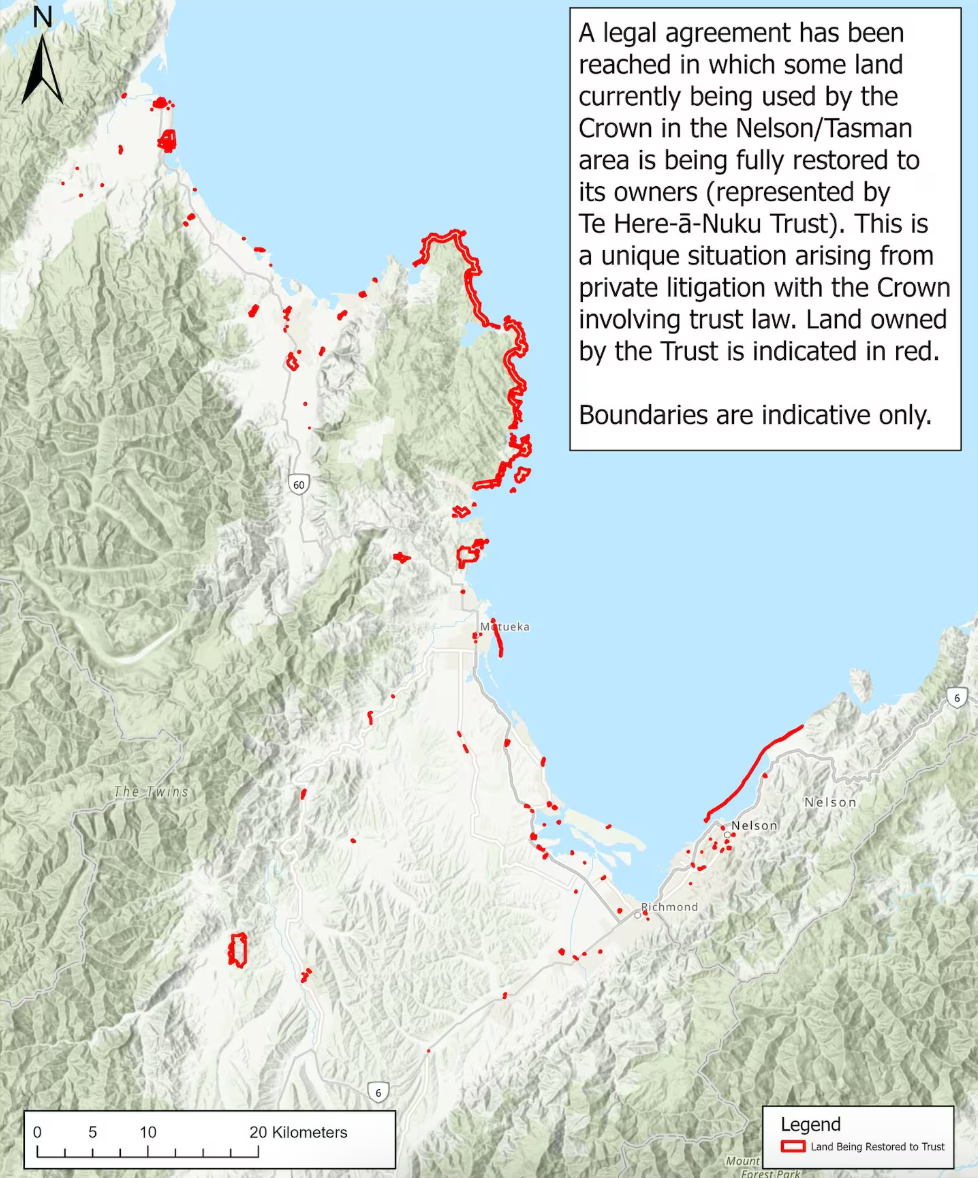
Courtesy of beehive.govt.nz, this image shows areas of land and foreshore to be returned to Te-Here-ā-Nuku trust.
Litigation History
Waitangi Tribunal
The promises were not upheld. Land sales by the Company saw the vast majority of the reserves be eroded (Proprietors of Wakatū at 424). The legal challenge to this began in earnest in the Waitangi Tribunal rather than the courts. The Wakatū Incorporation was created in 1977 with the purpose of administering the land that remained for the descendants of the beneficiary owners (Te Here-ā-Nuku Trust, n.d.). Kaumātua Rore Stafford, himself a descendant of the beneficiaries, filed a claim in 1986. It sought redress on behalf of Wakatū and was considered as part of the Tribunal’s broader report on the South Island. It found that breaches had been made, but the Crown’s policy of settling breaches with iwi bodies, not corporations, meant Wakatū would be excluded.
The Courts
Wakatū then turned to the courts to seek enforcement of the agreement in accordance with trust law. In the High Court, they sought relief “against the Crown”, claiming it was acting as a “trustee or fiduciary” and breached its duties by “failing to preserve” the land (Proprietors of Wakatū at [50]). In plain English, Wakatū asked the High Court to enforce the terms of the agreement the Crown had taken on.
The Court rejected the claim that the Crown became a trustee of the lands, concluding it took on a role that was “necessarily ‘political’” (Proprietors of Wakatū at [53]). That is, the government was acting in a capacity the courts could not scrutinise. It also found the Crown did not owe fiduciary duties, again on the ground that the action was political.
Eventually overturning the ruling, a majority of the Supreme Court found both that a trust had been created and that the Crown owed fiduciary duties to Wakatū. It found “overwhelming evidence” of intent to hold the land for the benefit of Māori, and the Crown dealt with the land on that basis (Proprietors of Wakatū at [416]). As examples, the Court pointed to documents showing the appointment of agents to lease the land “for the benefit of Māori” and description of the lands as “by their very nature inalienable” (Proprietors of Wakatū at [416(b) and (c)]).
Having found a duty was owed, the Supreme Court returned the case to the High Court to deal with the next issue: whether it had been breached and, if so, what remedy was appropriate. In a judgment of more than 1,000 paragraphs, it found the Crown was in breach (Stafford v Attorney-General [2024] NZHC 3110 at [36] and [40]). But before a decision was made on the appropriate form of compensation, Wakatū and the Crown reached a resolution out of court.
The Resolution and the Resolution Agreement
Restructuring the Trust
The first step in resolving the Crown’s breach was to restructure the trust recognised by the court as having existed since 1845. Te Here-ā-Nuku replaced the Crown, and once fully established will make mana whenua the stewards of the land to be returned. Trustees of Te Here-ā-Nuku are descendants of the original landowners.
Resolution Agreement*
The second step was the Resolution Agreement, signed on 17 December 2025. In it, the Crown agreed to the return of approximately 7,500 acres of land (roughly 30 square kilometres) and financial compensation of $420 million to provide redress for land that cannot be returned (Te Here-ā-Nuku Trust, 2025).
Te Here-ā-Nuku (Nelson Tenths) Bill
To crystallise the Agreement, the Te Here-ā-Nuku (Nelson Tenths) Bill was introduced on Monday 22 June 2026. Once enacted, its most significant effect will be the transfer of legal title to the customary owners (Te Here-ā-Nuku (Nelson Tenths) Bill 2026 (328-1) (explanatory note) at 10). Part 2 of the bill gives recognition to Te Here-ā-Nuku trust, and excludes it from the standard rule that a trust can only survive for 125 years (cl 21; s 16 of the Trusts Act 2019).
Part 3 of the bill deals with land currently within the Abel Tasman National Park. Clause 23 provides that the land will cease to be national park land immediately before it is transferred, then becomes trust property, before again becoming part of the Abel Tasman National Park. This legal fiction allows the land to be transferred in accordance with law and provides private ownership and use by the trust’s beneficiaries, while continuing public access through a licence granted to the Department of Conservation (cls 24-26). Part 4 provides for a similar framework to continue several scenic and recreational reserves that overlap with areas of land to be returned.
Finally, a clause in Part 6 will officially correct the spelling of Kaiteretere and natural features which bear the name (cl 132). To put these changes into practice, more than $2 million will be spent by DOC this year in operational costs, with further funding of over $7 million set aside until 2029 (Williams, 2026). The education ministry will also be paying the trust approximately $12 million over a five-year period for the lease of school properties (Williams, 2026).
The bill had its first reading on 25 June 2026. In his capacity as Attorney-General, Christopher Bishop spoke in recognition of the four decades of advocacy by kaumātua Rore Stafford, including the 15 years of “private law litigation” ((25 June 2026) 794 NZPD (Te Here-ā-Nuku (Nelson Tenths) Bill – First Reading, Chris Bishop)). He hopes to get the legislation passed before the general election (Te Ao Māori News, 2026).
Across the aisle, Labour Party spokesman for Māori Development, Willie Jackson, indicated Labour would support the bill. Jackson said it was “ironic” that the “biggest anti-Māori government in history” was progressing the draft legislation (Te Ao Māori News, 2026). He said a resolution had been considered by the previous government, but “ministers were required to work through significant legal and financial implications” (Te Ao Māori News, 2026). Indeed, former Attorney-General David Parker sought a “settlement proposal” from the “customary owners” following the Supreme Court’s decision (Johnston, 2023).
Te Pāti Māori member for Tāmaki Makaurau, Oriini Kaipara, said, “[t]his is not a gift; this is the Crown finally facing its own behaviour” ((25 June 2026) 794 NZPD (Te Here-ā-Nuku (Nelson Tenths) Bill – First Reading, Oriini Kaipara)). Trustee and project leader Kerensa Johnston says the bill resolves “longstanding uncertainty for our people and region, upholds the rule of law and property rights relevant to all New Zealanders, and heals rifts that are generations deep” (Williams, 2026).
Conclusion
Writing for E-Tangata, Kerensa Johnston asked, “[w]hat would the lives of our families look like had the Crown adhered to its side of the bargain in 1845 and fulfilled its obligations as trustee?” (Johnston, 2023). That question has no answer. Instead, Te Here-ā-Nuku and its beneficiaries must now “reimagine” their future based on “aspirations” of their tūpuna for a “brighter… landscape”, in every sense of the word (Johnston, 2023). But will the return of land under the bill – and the corresponding stewardship rights – enable this? At the very least, it “marks the opening of a chapter… of a new story to be written in the northern South Island” ((25 June 2026) 794 NZPD (Te Here-ā-Nuku (Nelson Tenths) Bill – First Reading, Chris Bishop)).
*Note: the Resolution Agreement is not publicly available. This paragraph provides the greatest detail possible. Clause 135 of the bill requires that, once enacted and if a member of the public requests, the trustees of Te Here-ā-Nuku must publish a redacted copy on their website.
References
Johnston, K. (2023, August 13). The Nelson Tenths: A story of unmet obligations. E-Tangata. https://e-tangata.co.nz/history/the-nelson-tenths-a-story-of-unmet-obligations/.
Museum of New Zealand Te Papa Tongarewa. (n.d.). The New Zealand Company. Collections Online. https://collections.tepapa.govt.nz/topic/1216.
Proprietors of Wakatū v Attorney-General [2017] 1 NZLR 423, [2017] NZSC 17.
Stafford v Attorney-General [2024] NZHC 3110.
Te Ao Māori News. (2026, June 23). National introduces bill to return 3,000 hectares and $420m to Māori in historic Nelson Tenths resolution. https://www.teaonews.co.nz/2026/06/23/national-introduces-bill-to-return-3000-hectares-and-420m-to-maori-in-historic-nelson-tenths-resolution/.
Te Here-ā-Nuku (Nelson Tenths) Bill 2026 (328-1). https://bills.parliament.nz/v/6/1f8553da-f9b8-4aa9-302b-08ded017bcbd.
Te Here-ā-Nuku Trust. (2025, December 17). 'Hugely positive' agreement in long-standing private property case. Te Here-ā-Nuku | Making the Tenths Whole. https://tehereanuku.nz/hugely-positive-agreement-in-long-standing-private-property-case/.
Te Here-ā-Nuku Trust. (n.d.). Home. Te Here-ā-Nuku | Making the Tenths Whole. Retrieved June 30, 2026, from https://tehereanuku.nz.
Williams, D. (2026, May 29). Budget millions from across govt to put right historical land wrong. Newsroom. https://newsroom.co.nz/2026/05/29/budget-millions-from-range-of-agencies-to-put-right-historical-land-wrong/.



Comments